
Making malignant meat
April 25th, 2026
My birthday came and went last month! Not much in the way of new sentiments; a few friends treated me to dinner and helped me pick up some goodies and hey, that's a day well spent I think. :]
Over the past month, I've been messing with seitan recipes a lot more lately in an attempt to find the easiest (yet tastiest!) forms for a good while now. For the uninitiated, seitan is a plant-based protein made from vital wheat gluten, a component generally used in bread. Anyone who eats plant-based in any capacity has likely noted how much more expensive plant substitutes are; for people willing to put in the effort (and who don't have a gluten intolerance, anyway), seitan is a gateaway into flexible, endlessly versatile protein that can capture a delightfully chewy texture. When made well, there isn't anything quite like it! I barely consider myself a cook nor is this meant to be a cooking blogsite, so please don't place too much weight on my words, but I figured I'd share some of my findings and personal discoveries, in the hopes that I can help some other folk out who are interested. ^^
I'd say one of the biggest walls with seitan is probably that every little ingredient and form of preparation matters in regards to the texture. If you're working with vital wheat gluten and just use it as-is, the end result becomes very rubbery and doughy— it's as unappetizing as it gets. In addition, if you're trying to simmer it, you have to be careful not to boil it— that'll just fill with holes and turn it disgustingly spongey and juicy. Ah, I did this to some nugget bites once and I was filled with misery for the rest of my night... All those things matter!
I saw a recipe online a little while back for an "easy seitan loaf", but perplexingly it used a vital wheat gluten method, but with no real ingredients to cut the gluten up with— the creator seemed to understand how rubbery the result was, because he suggested using a very sharp knife or even freezing the loaf to cut it properly. It was a bit baffling, if only because it's actually very easy to make a workable form of seitan without too much in the way of extra ingredients or prep.
Personally, when I'm in the kitchen and messing with recipes to use frequently I'm often trying to hit the balance between efficiency and results. I like to save the big, intensive formulas where I do the best preparation methods for special occasions or Friday nights, but on a nothing-special day I want something I can consider delicious without expending too much in effort or ingredients, even if it isn't the most delicious. Going back to the talk about texture: Early in I discovered what I felt was probably the absolute best recipe for deli rolls, Thee Burger Dude's Vegan Turkey Deli Slices. It's delightfully moist and very savory! The key to this is tofu, and if you've had Tofurkey, it uses a similar combination of tofu and vital wheat gluten to provide a wonderfully moist, meaty texture. It's delightful. If I had the patience I'd make it every day! BUT it requires you to blend super firm tofu. And to be plain and lazy... I don't always feel like doing that! In general, I try to avoid blenders and processors if I can help it because the combination of needing to get out another appliance and the cleanup step make things a little more intensive than I'd like. Of course, this is just me, but I feel like this is worth clarifying since it's a decision that paints my personal recipes and approaches.
To sum up my personal, reliable base seitan recipe that I use for deli meat, it pretty much comes down to this:
- 1 ⅔ cups vital wheat gluten
- ⅓ cup chickpea flour
- 2 cups water or broth
- ¼ cup nutritional yeast
- 2 tbsp of oil
If you've never made seitan before, it's a relatively painless process. Add everything dry (the gluten, chickpea flour, and nutritional yeast) to a bowl, mix it together very well, then add the water/broth and the oil. Knead it for a little while until it comes together (from my experience, you can't really over-knead something like this!) and then roll it up tightly in some heavy duty aluminum foil. Stick it in a steamer basket and run it for an hour. Flip it halfway through! Pull it out, let it cool, stick it in the fridge and give it overnight. Then, do whatever you want with it! This loaf always lasts me at least two weeks of lunch sandwiches for work. Slice it up for subs! The ends tend to get craggly and funny looking from my experience because of the foil, but of course they're perfectly edible; when I reach the "ugly" looking ends of my loaf, I like to break it up into meat chunks and use them for loaded nachos or fries. I ❤️ optimization.
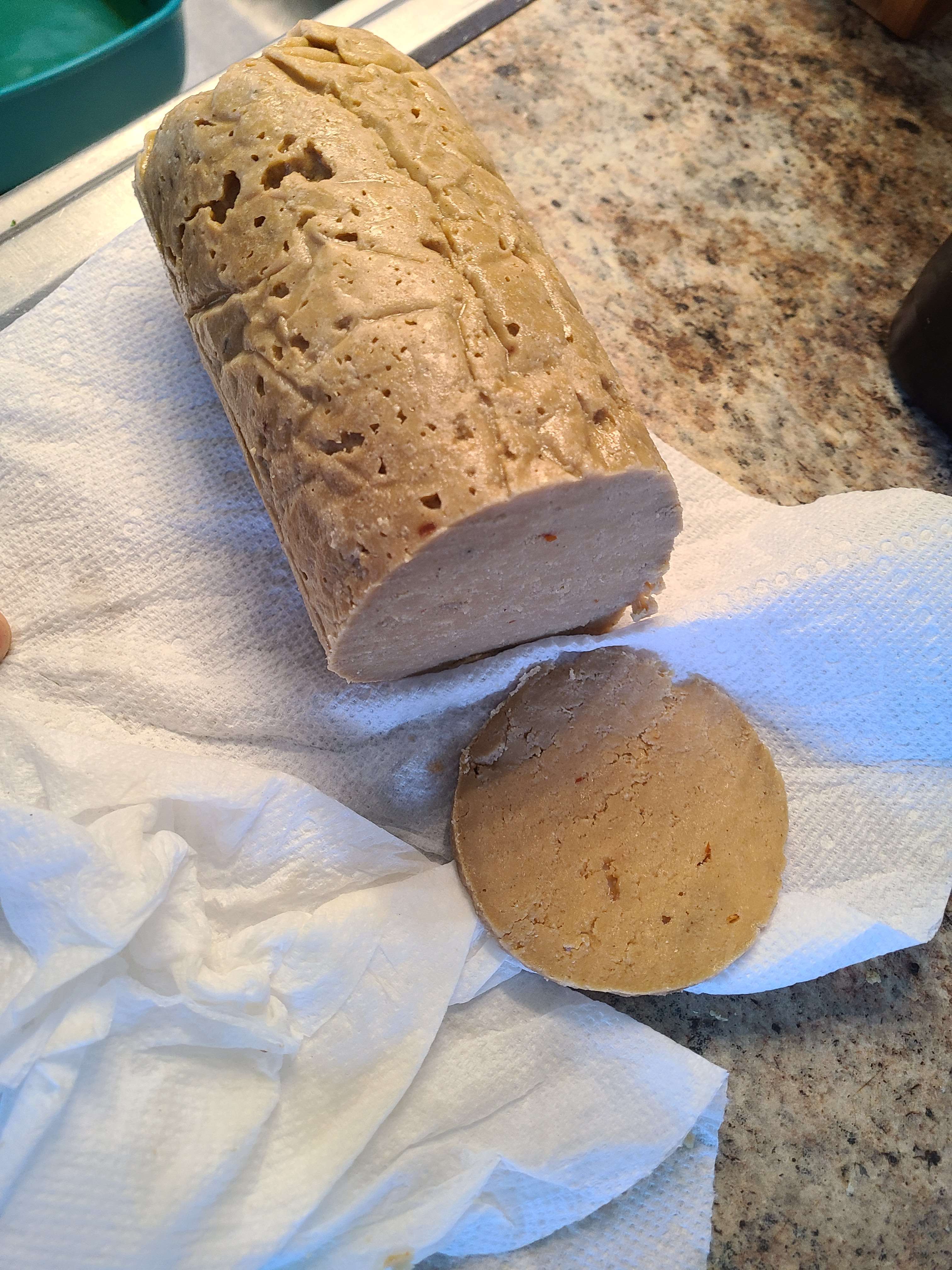
A loaf I made, lighter on seasonings than my usual, with its main flavorings being a vegetable broth and mushroom powder. Without a meat cutter, I typically have to go at it with a knife, and I'm not the best at cutting, but that's okay. It's all going in your mouth at the end!
The big baby here is chickpea flour. You'll find many other seitan recipes will use chickpea flour too. There are more high-quality ways to get 'er done, such as using an actual can of chickpeas (which I do certainly recommend; the aquafaba benefits the texture much more than regular chickpea flour would!). But remember that I'm a bum, and I'm optimizing for a speedy yet good result. Chickpea flour cuts up the gluten perfectly well, preventing it from becoming gummy or rubbery. Instead, it gains a nice, pleasant, meaty chew. Make sure not to forget the oil and water, either, or your loaf will become hilariously dry.
The key word here, and the fun part about seitan and many plant-based proteins in general, is that this is my base recipe, and not the one I'll actually follow to the letter! To flavor it, you can do any number of things. For the dry mix, I'll generally add 2 tbsp of mushroom seasoning, 2 tsp MSG, 2 tsp onion powder, and 2 tsp garlic powder. You can throw in pretty much anything in your spice cabinet, so feel free to experiment. The wet mix can be altered too for flavor— my go-to broths I use are Better Than Boullion Vegetable Base and Better Than Boullion No-Chicken Base, and both of those do very different things to the taste of the final result. You can also add liquid smoke or miso to the broth as well. I'd start with 2-tsp additions as far as spices go, and then proceed from there. The world is your oyster...
Again, I should stress this isn't going to get you the best in seitan tech by any means. This is squarely the tried-and-true personal loaf that I've created, which best balances cost, time, effort and ingredients for me, while still being flexible enough to taste like what you want. Compared to using tofu, you'll find chickpea flour alone gives it a little more of a brittle feel, but it'll still be very meaty.
And those're my findings! It's fun to work towards a better result in the kitchen, and even better to eat it 😊 A lot of plant-based proteins, such as tofu and tempeh, have a very neutral taste and rely on seasonings and flavorings to get the most out of them, so in general it feels like eating plant-based has been a continuous journey in finding new tastes and ways to use these staples. Compared to your chicken or beef, the flexibility can seem overwhelming, but can be very freeing. Even if you aren't vegan, at the least I would try to look into playing around with plant protein foods, especially seitan!